Architecture diagram
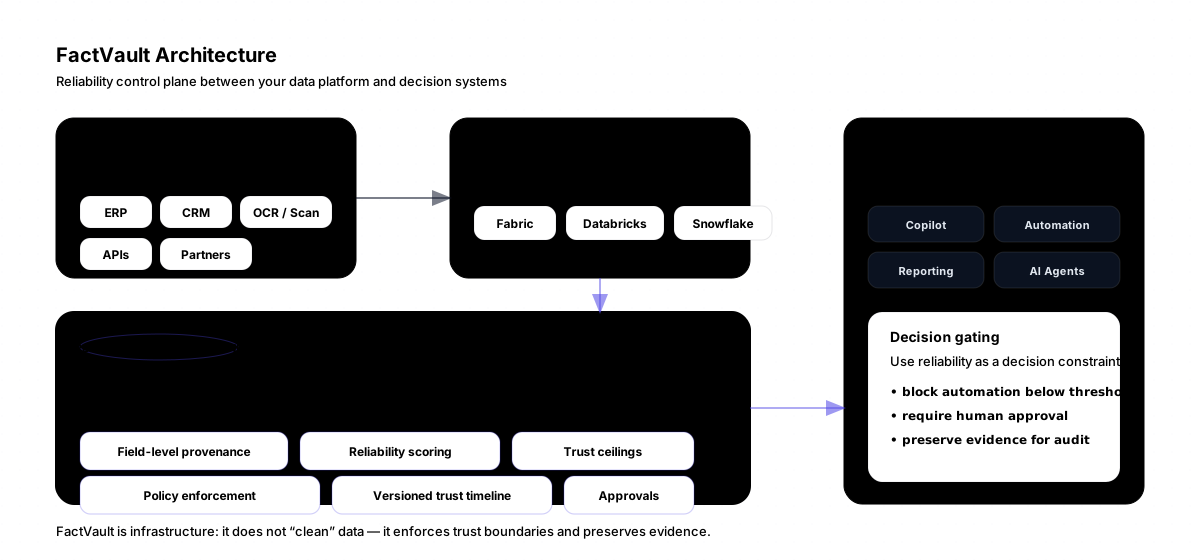
FactVault operates as a minimal moving-parts service: it ingests multi-source records, preserves field-level provenance, and produces versioned outputs with enforceable trust boundaries.
What FactVault enforces
Trust boundaries (policy)
Decisions should not rely on fields that are low-confidence, externally claimed without approval, or missing provenance. FactVault makes these constraints explicit and enforceable.
Field-level provenance
Every output field retains its source, source field, and reliability — so the chain of evidence remains inspectable, not inferred.
Versioned trust evolution
FactVault versions reliability over time, so organizations can answer: “What did we know, and how reliable was it, when the decision was made?”
Human-in-the-loop governance
When required, decisions can be gated behind approvals. Confirmations and rejections flow back into reliability, triggering recalculation and traceable impact.
What FactVault is not
FactVault is designed to complement your platform, not replace it.
- Not a data warehouse — it does not store your full enterprise dataset for analytics.
- Not an MDM suite — it does not claim to be the “one truth”; it preserves defensible truth.
- Not a catalog — it does not just document lineage; it enforces reliability at decision time.
- Not monitoring — it is an infrastructure control plane for decision trust.
Want the precise definition of trust used here? Read What is Data Trust? or download the Data Trust & Reliability Authority Document.
Integration points
FactVault is intentionally minimal and infrastructure-friendly. It typically integrates at three points:
Ingest
Push SourceRecords from systems (CRM, OCR, SharePoint, APIs) into FactVault. Normalize fields at the edge so comparisons remain deterministic.
Enforce
Apply reliability caps, source whitelists, and approval policies. Reliability becomes a first-class, versioned data primitive.
Consume
Output, in the form of FactSets, feeds AI systems, reporting, automation, or downstream services — with preserved provenance and enforceable trust boundaries.
Current Integration
This architecture is currently being explored in integration scenarios with AI workflow and automation platforms, where FactVault acts as a control plane that determines whether actions are allowed based on data reliability.