Where FactVault fits in a Microsoft stack
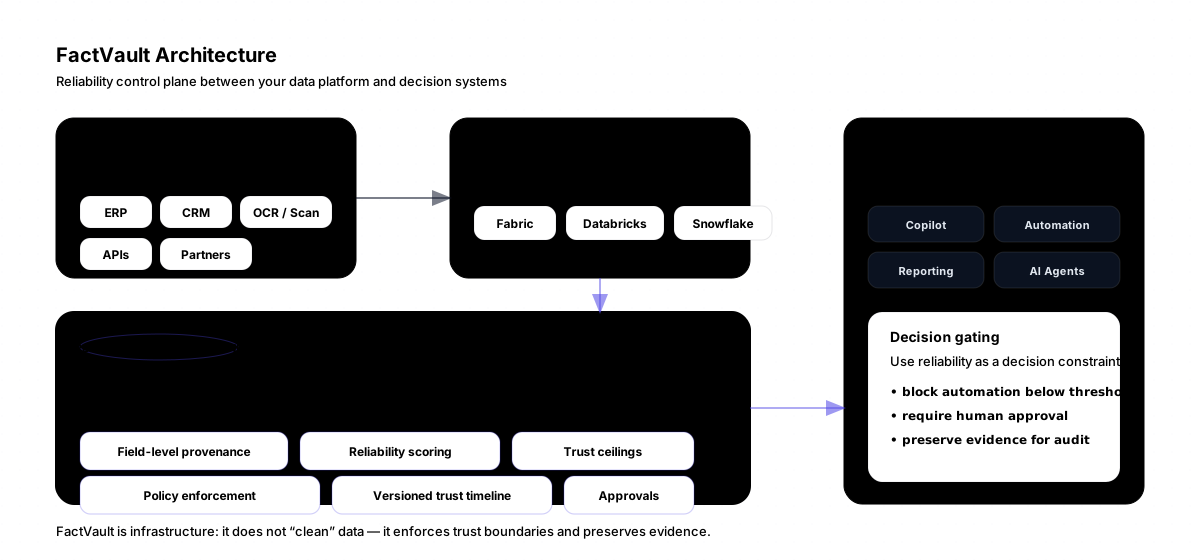
FactVault is designed as an infrastructure component: a reliability control plane between data platforms and decision systems. It does not replace Fabric, Purview, or Copilot — it adds an enforceable layer that binds automation to evidence.
The Copilot trust gap (in practice)
Copilot can be “confident” while still being unjustified. The risk is not only hallucination — it is the silent upgrade of low-quality or externally claimed data into “decision-grade truth.”
When confidence masks weak evidence
A model may produce a polished answer even when key fields are missing provenance, stale, conflicting, or below the reliability threshold required for the decision.
Trust ceilings prevent silent escalation
FactVault can cap externally claimed reliability and require policy approval before “trusted” signals cross into decision-critical paths.
This is why trust must be treated as a decision constraint, not a dashboard metric. See The AI Trust Gap and What Is Data Trust?.
How this complements Fabric & Purview
Microsoft already covers identity, platform, and governance foundations. FactVault adds reliability enforcement at the granularity decisions are made: per field, per source, per moment in time.
| Microsoft layer | What it provides | What FactVault adds |
|---|---|---|
| Azure | Compute, storage, security foundation | A minimal-infrastructure reliability control plane built for cloud-native deployment |
| Fabric | Data platform for ingestion, storage, analytics | Field-level reliability propagation into downstream consumers (no flattening of provenance) |
| Purview | Cataloging, classification, governance visibility | Policy-enforced trust boundaries, trust ceilings, and versioned trust evolution |
| Copilot / Agents | AI interface and execution layer | Decision gating: block, require approval, or permit actions based on reliability thresholds |
Enterprise outcomes
Reliability enforcement becomes a practical lever for Responsible AI and enterprise defensibility:
Audit-ready decisions
Preserve evidence: what data was used, from which sources, with what reliability — at the time the decision was made.
Reduced blast radius
Prevent low-reliability fields from powering high-impact automation. Use policy thresholds to constrain actions.
Human control where it matters
Require approvals on specific fields, sources, or link events — with traceable impact on downstream trust.
Faster AI adoption with guardrails
Reliability makes trust a measurable engineering property, accelerating adoption while maintaining defensibility.